Ask most buyers what makes a Siesta Key property a good short-term rental candidate and you will hear about the beach. Powder-fine quartz sand, a five-minute walk to the Village, maybe a Gulf view from the balcony. Almost nobody mentions the parcel's zoning designation. They should, because on this island the zoning line does more to determine rental legality than the shoreline ever will, and the same rental activity that makes a building profitable to run can be the exact thing that makes it hard to buy.
That second part is the piece most guides skip. It is also the one that costs buyers real money and real time when it surfaces mid-contract instead of before an offer goes in.
The Line the Listing Photos Don't Show
Most of Siesta Key sits in unincorporated Sarasota County, where the default rule is a 30-day minimum on any lease. That prohibition applies island-wide to single-family and multi-family zoned parcels, including Siesta, Casey, and Manasota Keys, with one carve-out: parcels zoned Residential Multi-Family (RMF) on the barrier islands are allowed to rent for less than 30 days once properly licensed. A single-family (RSF) house two doors down from an RMF-zoned condo building can be legally worlds apart for rental purposes, even though both are steps from the same stretch of sand.
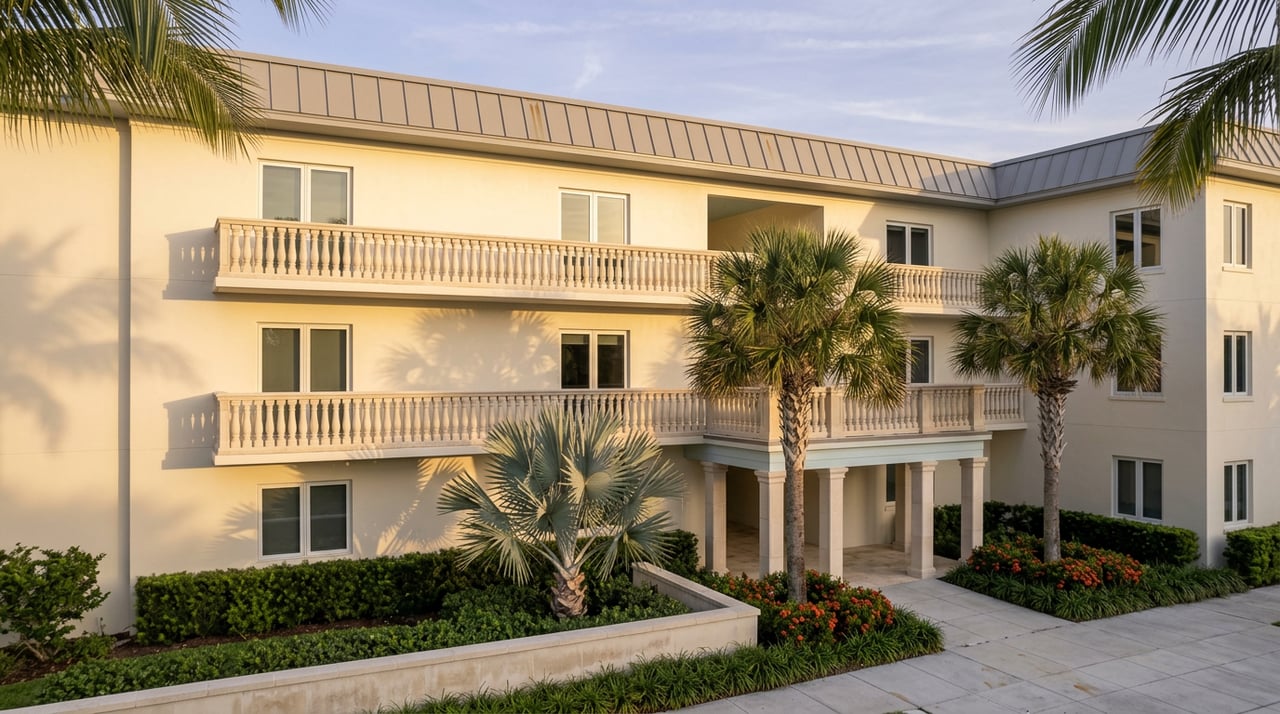
That distinction has quiet consequences for inventory. A 2022 county tax roll cited by the Sarasota News Leader put unincorporated Siesta Key at 2,381 single-family homes against 6,793 condominium units. Most buyers picture a house when they imagine a Siesta Key vacation rental, but the zoning code points them toward the condo stock instead, since that is where the RMF exception actually lives.
There is a third layer most buyers never think to ask about until the closing table. A small piece of north Siesta Key falls inside City of Sarasota limits rather than unincorporated county territory, and the city runs a different rulebook entirely.
Three Rulebooks, Same Island
| Jurisdiction | Minimum stay | What a legal short-term rental requires |
|---|---|---|
| Unincorporated Sarasota County (most of Siesta Key) | 30 days, unless RMF-zoned | County vacation rental license, state DBPR license, tourist tax registration |
| City of Sarasota (north-end sliver) | 7 full days and 7 full nights | Certificate of Registration under Ordinance 25-5560, annual safety inspection, a responsible party reachable 24/7 |
| Individual condo or HOA | Set by the declaration | Whatever the association's governing documents allow, regardless of what zoning permits |
The city's rules matter more than their small footprint suggests, because Ordinance 25-5560, adopted in 2025 and fully in effect this year, tightened enforcement and requires proof of occupancy for owners claiming the owner-occupied exemption. A property just a few blocks from the county line can be running under a completely different playbook than the one across the street.
And the third row in that table can override the first two entirely. A condo association's declaration can prohibit short-term rentals outright even inside an RMF zone, or it can permit them even where the building sits comfortably within city registration requirements. Zoning tells you what the government allows. The declaration of condominium tells you what the building actually allows. Buyers who check only one of the two are checking half the picture.
The Paradox: Rentability and Financeability Pull in Opposite Directions
Here is the part that catches serious investors off guard. Conventional mortgage financing through Fannie Mae and Freddie Mac depends on a building being classified as warrantable, and warrantability rests heavily on owner occupancy. Lenders generally want at least half of a building's units occupied by owners rather than rented out. A building that operates like a hotel, with a rental desk, daily housekeeping, or an active rental program, fails that test almost automatically and gets labeled a condotel, which conventional lenders will not touch at all.
In other words, the busier and more successful a building's short-term rental program becomes, the more likely it is to slide out of conventional financing eligibility. The unit itself can be flawless. New kitchen, water view, perfect inspection. The problem lives at the building level, in the ownership mix and rental activity, not in anyone's four walls.
Florida adds a second layer on top of that. Post-Surfside reforms including SB-4D require milestone structural inspections and fully funded reserve accounts for older buildings, and a condo with an open finding or underfunded reserve can slip into non-warrantable status until the association clears it. A building can fail warrantability for rental activity, structural compliance, or both at once.
When a building lands in non-warrantable territory, financing does not disappear, but it narrows. Buyers typically move to a portfolio or non-QM loan, often putting down 20 percent or more, sometimes closer to 30, at a higher rate than a conventional buyer would pay. That changes the math on a deal that looked attractive purely on nightly rate and occupancy.
It also changes who can buy the unit from you later. A resale buyer who needs a conventional loan may simply not qualify to buy into a building that rents beautifully but finances poorly, which shrinks the pool of people who can make you an offer when it is time to sell.
What This Changes Before You Write an Offer
None of this means Siesta Key is a poor rental market. It means the sequence of due diligence matters more than the sequence most buyers follow.
- Confirm the parcel's zoning designation with Sarasota County before assuming a house or condo can legally rent short-term.
- Request the declaration of condominium and any rule amendments, since association rules can be stricter than zoning and are enforceable regardless of what the county allows.
- Ask for a condo questionnaire or warrantability check before writing an offer, not after going under contract, so financing terms are known in advance rather than discovered during underwriting.
- Verify whether the property sits in unincorporated county or the City of Sarasota's north-end footprint, since the minimum stay and registration requirements differ.
- Confirm current DBPR license status if a seller represents the unit as an active rental, since a change of ownership typically requires a new certificate of registration.
Working through that order before an offer is written protects earnest money and avoids the scenario where a buyer discovers, three weeks into a contract, that the building they love cannot be financed the way they planned.
A Few Questions Worth Settling Early
Can I buy a single-family home on Siesta Key and run it as a nightly rental? Generally no, if the parcel sits in unincorporated Sarasota County and is zoned RSF. The county's 30-day minimum applies to single-family zoning island-wide, with the RMF exception reserved for multi-family zoned parcels.
Does the whole island follow the same rules? No. Most of Siesta Key falls under Sarasota County's 30-day rule with the RMF carve-out, while a small north-end section sits within Sarasota city limits and follows a 7-night minimum under Ordinance 25-5560.
If a previous owner ran the unit as an unlicensed rental, is that my problem now? It can be. Prior unlicensed rental activity can create compliance questions for a new owner depending on how the purchase is structured, which is a detail worth raising during offer negotiations rather than after closing.
Siesta Key remains one of the strongest vacation rental markets on Florida's Gulf Coast, but the building matters as much as the beach. Buyers who verify zoning, read the declaration, and check warrantability before they fall in love with a unit end up with a purchase that rents the way they hoped and finances the way they expected.
If you are weighing a Siesta Key property against its rental potential, resale liquidity, and financing path all at once, Flota'cal Real Estate & Property Management works across brokerage, long-term management, and vacation rental operations on this island every week and can walk the zoning, association, and licensing questions with you before you write an offer. Experience Seamless Buying & Selling.